



The Manelli Scale Explained: How I Grade Every Bleach (And What the Numbers Really Mean)
The 100-point framework behind every bleach review on this site — and how to use it to make smarter product decisions for your clients and your salon.
Jump to section
What Is the Manelli Scale?
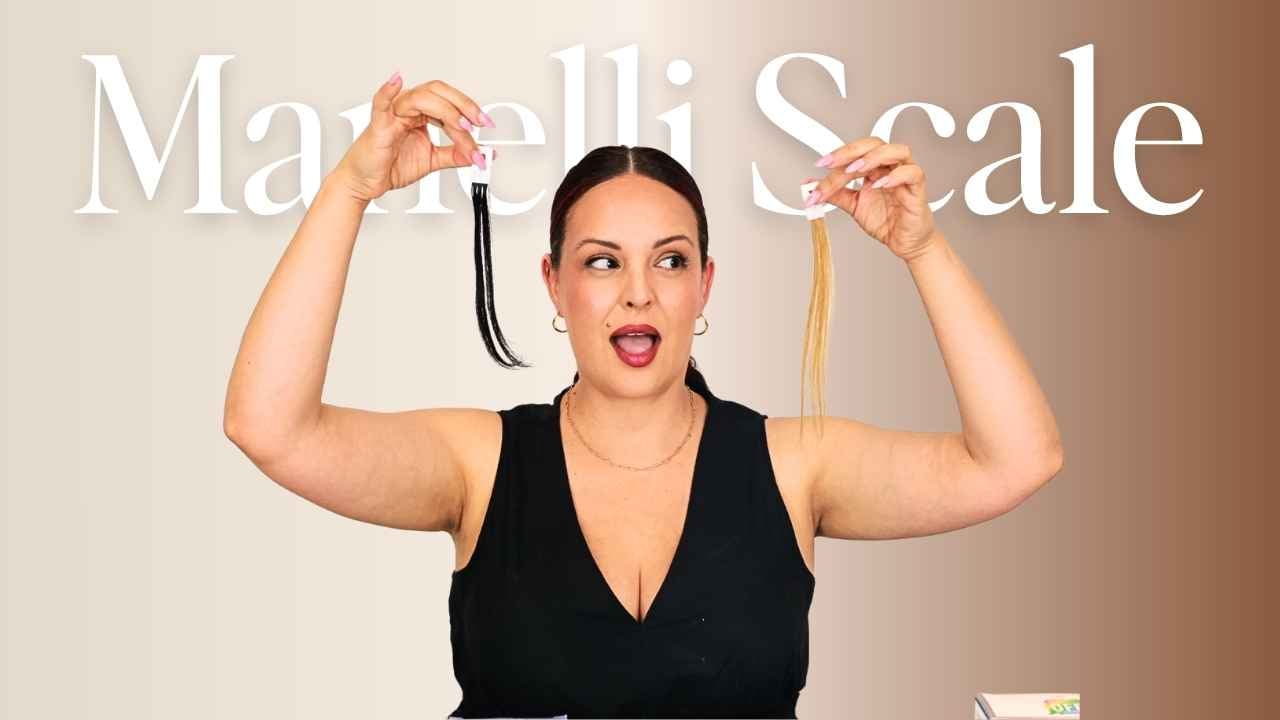
The Manelli Scale is a standardized 100-point hair bleach evaluation system developed by Mirella Manelli, a professional hairstylist and educator with over 20 years of industry experience. It rates every lightener across exactly 10 categories, each scored from 1 to 10, for a maximum possible score of 100. The system was designed so professional stylists can compare bleaches objectively, independent of brand marketing or affiliate incentives.
The 10 Manelli Scale categories are:
| # | Category | What It Measures |
|---|---|---|
| 1 | Dust | Airborne powder released during mixing |
| 2 | Odor | Smell intensity and quality during processing |
| 3 | Viscosity | Consistency and control during application |
| 4 | Timing | Predictability and grace window |
| 5 | Swell | Expansion of product on hair during processing |
| 6 | Lift | Levels achieved and evenness of lightening |
| 7 | Integrity | Hair condition after processing |
| 8 | Neutralization | Toner readiness and residual warmth |
| 9 | Versatility | Range of techniques and hair types it handles |
| 10 | Price | Value per use for a working salon |
If you have ever landed on one of my bleach reviews and wondered, what exactly does a 7.8 out of 10 mean for viscosity — this post is for you.
I get questions about the Manelli Scale constantly. In comments, in DMs, from stylists at classes. And honestly, I love that you are asking, because it tells me you are the kind of professional who does not just want to know which bleach I recommend. You want to understand why.
That is exactly the spirit behind this system. So let me pull back the curtain completely.
Why I Built a Rating System in the First Place
After more than 20 years behind the chair and in the salon education space, I have tested more bleaches than I can count. And for most of that time, I did what everyone else does — I formed opinions based on feel, intuition, and client results. That is not a bad thing. Experience is irreplaceable.
But here is the problem I kept running into: when I would recommend a bleach to a fellow stylist or a student in one of my programs, they would come back with completely different results. Not because the bleach had changed. Because their situation had. Their water. Their developer brand. Their mixing ratios. Their processing environment.
I realized that “this is a great bleach” is almost a useless statement without context. Great for what? Great compared to what? Great according to whose standards?
So I built the Manelli Scale.
It started as notes I was keeping for myself — a structured way to evaluate each product I tested so I could look back and compare apples to apples. Ten categories. Ten points each. A hundred-point system that forces me to get specific rather than vague. Over time, it became the backbone of every review I publish. It is the reason I can tell you with confidence that one bleach scores a 9 on lift but only a 5 on integrity — and why that distinction matters enormously depending on your client’s starting level and hair history.
This is not a “best of” list built on brand relationships or affiliate incentives. It is a technical scorecard built by a working professional, tested in real conditions, with real hair.
The Ten Categories, Broken Down
Here is exactly what I am measuring — and what the numbers mean in practical terms for a working stylist.
1. Dust (1–10)
Dust refers to how much airborne powder the bleach releases when you open the container and when you mix it. Beyond the obvious health considerations, heavy dust also signals inconsistent particle size in the powder itself, which can affect how evenly the bleach mixes and performs.
2. Odor (1–10)
I score based on both intensity and quality of the smell, because some bleaches have a sharp chemical bite that dissipates fast, while others have a lower-intensity odor that lingers for hours. For stylists who work in small spaces or with sensitive clients, this category carries real weight.
3. Viscosity (1–10)
Viscosity directly impacts your precision. If you are doing fine weaves or baby lights, you need a bleach that stays exactly where you put it.
4. Timing (1–10)
Unpredictable timing is one of the top reasons stylists end up with uneven results. I score heavily here because consistency is everything.
5. Swell (1–10)
For on-scalp applications especially, swell can be the difference between a clean result and a mess.
6. Lift (1–10)
This is the one everyone wants to know about first — and I always remind stylists it is only one of ten for a reason. I test lift on consistent starting levels so the scores are comparable across products. Want to see the lift testing live? Watch me put 50+ bleaches through their paces at Cosmoprof: I Tested EVERY Hair Bleach Lightener at Cosmoprof →
7. Integrity (1–10)
Lift without integrity is damage. If you are working on clients with previously colored or compromised hair, integrity scores should be the first thing you look at after lift.
8. Neutralization (1–10)
For stylists who do a lot of blonding work, this score is critical for predictable, repeatable results.
9. Versatility (1–10)
High versatility matters if you want a go-to product that can handle your full client roster.
10. Price (1–10)
Price is not about cheap versus expensive. It is about value — cost per ounce, product needed per service, and whether the performance justifies the price point. Your product costs directly affect your profitability. I do not ignore that.
Why 100 Points Instead of a Simple Ranking
A ranked list is satisfying to read. “Number one is best, buy that one.” I get the appeal.
But hair is not that simple, and neither are the professionals using these products. A bleach that ranks number one on my overall list might be completely wrong for your specific situation. Maybe it swells heavily and you do foil work on fine hair. Maybe it has a strong odor and you work in a small studio. Maybe it performs brilliantly but the cost-per-use kills your margins.
The Manelli Scale gives you a breakdown that is actually useful. You become the decision-maker — not me.
How to Use the Manelli Scale When Choosing a Bleach
Match your top priorities to the relevant category scores:
- On-scalp color (roots, all-over): Prioritize Swell and Timing
- Fragile or previously lightened hair: Go straight to Integrity and Neutralization
- Fine weaves or baby lights: Lead with Viscosity
- High-volume salon: Make Price and Versatility your anchors
- Small or poorly ventilated space: Weight Odor and Dust heavily
- Dark hair clients (Level 1–3): Start with Lift and Integrity together
Try the Manelli Scale
Use the interactive tool below to browse every bleach I have rated — filter by technique, sort by category, and compare products side by side.
Frequently Asked Questions